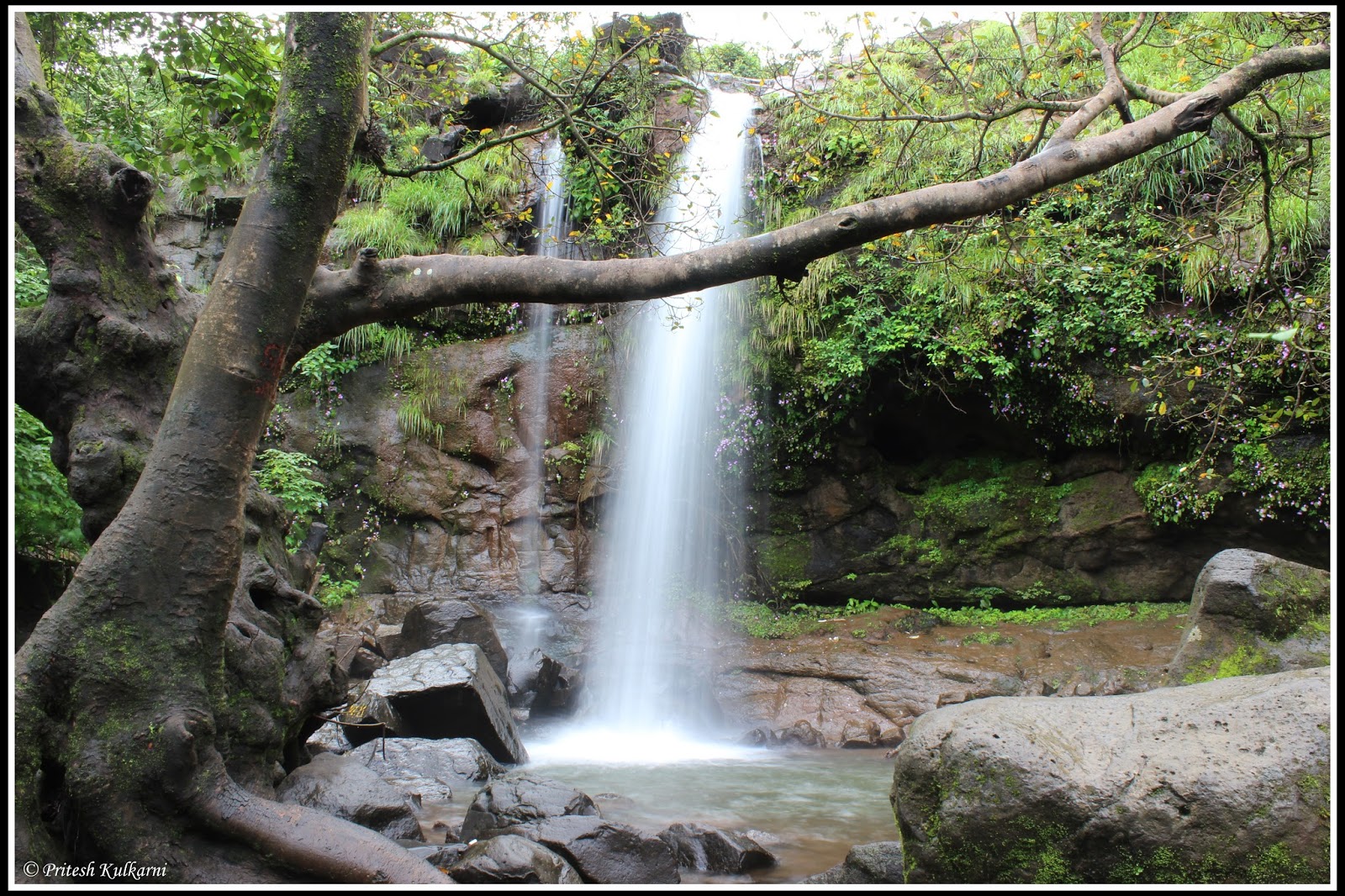
I have been to the Raigad fort twice for a day trip but had never explored the entire fort. In this monsoon, a 2 day trip to the Raigad fort was on my wish list. I along with my family planned a trip to Raigad considering the long weekend of Ganesh visarjan. It was our post monsoon trek. There was no sign of rain on day one but faced cloudy rainy weather on the second day. We booked a room in Raigad hotel which is owned by the ropeway operator.
 |
| Shivaji Maharaj ki JAY...!!! |
Travellers for Raigad trip were me, Renuka (wife) and my parents.
About Raigad Fort:
Raigad is a hill fortress situated near Mahad, in Raigad district. It was known as the mountain of “Rairi” before it was captured by Shivaji Maharaj. European historians have described it as 'The Gibraltar of the East'. On 6th April 1656, Shivaji Maharaj besieged Rairi and captured it in May. Then Subhedar of Kalyan was transporting the treasure of Adilshah to Bijapur, which was raided by Marathas and utilized to fortify Raigad. It became the capital of Shivaji's kingdom.
Raigad Fort has been a witness of significant events such as Shiv Rajyabhishek (The Coronation ceremony of Shivaji Maharaj – The Auspicious day was 6th June 1674, Saturday), 24th September 1674 Shivaji Maharaj underwent another ceremony of coronation for the commoners, 4th February 1675 Sambhaji Maharaj’s thread ceremony and 16 February 1681, Sambhaji became the crowned king of Maratha Empire. On 3rd April 1680, Shivaji Maharaj passed away on this fort, which was the most devastating moment witness by Raigad.
Aurangzeb started his conquest of Raigad in 1684 but failed and returned in 1685. Zulfikar Khan attacked Raigad in 1689. On 5th April Rajaram (King after Sambhaji and Son of Shivaji Maharaj) escaped to Pratapgad. Finally, on 3rd November 1689, Mughals captured Raigad due to unfaithful Suryaji Pisal. They renamed the fort as Islamgad. Marathas regained it on 5th June 1733. In 1818 the fort was bombarded and destroyed by British Raj. Some people say (No evidence is available) that the royal fort was burning for 11 days.
The fort was called by 15 different names at different times – Raigad, Rairi, Islamgad, Nandadeep, Jambudweep, Tanas, Rashivata, Badenur, Raigiri, Rajgiri, Bhivgad, Reddi, Shivlanka, Rahir and Gibraltar of the east.
There are 2-3 ways to reach to the fort from Pune. One is via Varandha Ghat, whereas another route is Pune – Chandani chowk - Tamhini Ghat – Mangaon – Take left before Mahad – Pachad village – Rope way base station. If you are planning a trip to Raigad during post-monsoon time then I will suggest you go by the third route which is Pune - Tamhini Ghat – Nijampur - take left at Nijampur and then base village Pachad. This route is blessed with nature’s beauty during monsoon or in post monsoon. However, currently, the condition of the road is poor near Pachad village.
 |
| Waterfall at Tamhini |
 |
| Waterfall near Raigad |
7th Sept 2014: Trip to Raigad (Total Distance traveled: 160 km):
We woke up by 5.30 AM and left home at 7:00 AM. We chose the route via Mangaon. It was a cloudy weather and rain welcomed us in Tamhini Ghat. We took a pit stop for breakfast at Hotel Quick Bite. It was a pleasant journey till Raigad base village. When we reached the base village, soft sunlight played its best role to unfold nature’s beauty in front of us. Even though it was a Sunday, there were hardly any tourists due to Ganesh festival. Waiting time for ropeway was just 15 minutes. Raigad ropeway is Maharashtra’s first ropeway project which was completed in 1996. It traverses a diagonal length of 760 meters and a height of 420 meters. It takes you on the top in just 3-4 minutes. The ropeway ride offers you a beautiful view of the Sahyadri Mountains and nearby villages.
 |
| Raigad rope-way |
 |
| Raigad ropeway and Base village |
We reached the top by 12 noon. Raigad ropeway hotel is located near the ropeway station. We checked-in and ordered Pithale bhakri for lunch. Soon we went out to explore the fort. On day one, we decided to explore Balekilla and Tak Mak Tok point. As I was aware of the history of the fort and the locations very well, I became the guide for my family. The starting point of our tour was the Mena Darwaja – the entrance through which the royal ladies of the Fort would enter. It is the southern entry to the castle. After entering the fort from the Mena Darwaja, we saw Rani Wada (Queen’s Palace) on our left. There are six spacious houses for 6 queens of Maharaja. Shivaji Maharaj had 8 Queens; 6 Queens stayed on Raigad fort, whereas one at base village Pachad along with Jijabai (Mother of Shivaji Maharaj) and 1st queen Saibai died on Rajgad (before Raigad was built). Queen palaces have ruined large rooms with and bathroom system. 4 palaces are connected whereas last 2 palaces are separated by walls.
 |
| Mena Darwaja |
 |
| Queen's Palace |
We saw some ruined house like structures opposite to first queen palace. Some people say those were Prison cells whereas some say those were houses of royal warriors. There are 3-grain storage rooms on the right after entering from Mena Darwaja. We saw the Palkhi Darwaja before we moved into Raj Bhavan. Palkhi Darwaja is the north entrance to the castle and was mainly used by men to enter the palace. The construction of the entrance and the 31 rock stairs are beautiful and look solid. You can see Sapt manzil (Pillars) which was used as a watchtower. These pillars were said to be almost five-story high and seemed royal from the remaining carvings. There is small stair route inside the wall to enter the palace. After watching these beautiful buildings, we went inside the Raj Bhavan. It was a beautiful massive palace of Shivaji Maharaj. It was said to be built of the wooden structure, of which today only the base of pillars remain. You can see his room’s structure, bathrooms, office for a discussion with his warriors etc. It was huge in size. We saw Ganga Sagar Lake from the Raj Bhavan. It was named Gangasagar because the waters from seven rivers of India which were brought for the coronation ceremony of Shivaji Maharaj were poured into this pond. This is the main source of drinking water today on the fort.
 |
| Houses of Royal warriors |
 |
| Grain storage |
 |
| Palkhi Darwaja |
 |
| Raj Bhavan - Mahajara's house area |
 |
| Raj Bhavan - Office area |
 |
| Ganga Sagar Lake |
After exploring Raj Bhavan for some time, we went in the Raj Sabha. It is a huge court on the fort which was used to address people. The huge building is around 220 ft. long and 125 ft. in width. The coronation ceremony was held in this place on 6th June 1674, Saturday. The throne of Shivaji Maharaj is kept in Raj Sabha facing east. The throne was made of 32 Maund of Gold (around 1280kn Gold) and studded with diamonds. There is huge shape entrance opposite to the throne known as Nagarkhana. It was the main entrance to the court, and as its name suggests, the loft on this building was used to play huge drums (Nagaare) during certain times in a day. Acoustically the Raj Sabha was designed in such way that you can hear low-frequency sound at the throne from the Nagarkhana.
 |
| Throne of Shivaji Mahajara |
 |
| Nagarkhana |
We move ahead to see the statue of Shivaji Maharaj at Holi cha maal. It is a wide open ground, said to be used for annual Holi festival. You can see a famous statue of Shivaji Maharaj on this ground facing east direction. We took a small break and then decided to go to Tak Mak Tok point. There are 2 ways to reach that point. One is – take right after crossing Bazarpeth or take stairs on left before Bazarpeth. We decided to go by the second route and while coming back, we saw Bazarpeth.
 |
| Statue of Shivaji Maharaj |
As we were going towards Tak Mak tok, we saw a large size Lake on the left. It is known as Hatti Talaw (Elephant Lake). It was used for bathing the elephants from the fort. There was drain out system places in the lake. Whenever they wanted to clean the lake, then they just needed to remove 1 solid rock brick. Drain out system rock is now missing hence water can’t be stored in this lake. You can also see Maha Darwaja (Main entrance) on your right. It is the best architecture design and not to be missed if you’re on the fort. This entrance is typically a “Gomukhi” entrance protected by bastions Jai and Vijay. The attacking enemy cannot directly march on the door and face the bastions first.
 |
| Mahadarwaja (Main Entrance) |
 |
| Hatti Lake |
After walking along the fields and on the narrow path, we reached near Tak Mak tok. There are 2 ruined buildings which were the Daru Kothar (Ammunition storage). The path to Tak Mak tok is quite interesting, a narrow path (with safe railing on both sides) facing North West having a deep cliff on both side and strong winds playing around it makes it a major attraction for the trekkers. You should be careful while visiting this place. We went till the endpoint which offers a breathtaking view of the Sahyadri Mountain ranges. This point was said to be used to throw the sentenced prisoners down the cliff.
 |
| Tak Mak Tok Point |
We spend some time at windy Tak Mak tok and enjoyed the magnificent view. As the weather was about to change its mood from a sunny day into cloudy weather, we decided to move back. The route to Bazarpeth (Old Market area) was a bit slippery with sudden height gain; my parents got the feel of the trek. Bazarpeth is huge well designed single story complex of shops. This was the marketplace/trade center having shops on both sides separated by a 40 ft. road. There were 42 shop structures built in such a way that one can shop even while riding a horse. Each shop has space to sell the goods, two rooms for storage and large passage behind two rooms. You can see drainage outlets at a few shops. Overall it’s a masterpiece construction.
 |
| Bazarpeth at Raigad Fort |
Heavy rain began in the evening and somehow we managed to reach our hotel room by 6 PM. We had snacks and tea/coffee and took rest. We ordered dinner and it was delivered at the top by ropeway at 8.30 PM. Now there was a drastic change in weather and we were in the clouds. Cold weather forced us to be in the room. Service by hotel staff was good. My parents were tired so they took rest whereas I and Renuka had a walk on the fort for some time. We were the only family on the fort along with the hotel and MTDC staff. It was a perfect day for us at Raigad fort.
 |
| Raigad Rop-way Hotel room |
8th Sept 2014: Trip to Raigad (Total Distance traveled: 132 km):
We woke up by 7 AM and still weather was too cloudy. It was not raining constantly but the visibility was not more than 25-30 ft. We had tasty breakfast and then left the room by 9.30 AM. Today was Anant Chaturthi (Ganesh Visarjan day) hence hardly any tourists were on the fort. We decided to visit some other places which are on off-beat route and day trip tourist always ignore it (except Shivaji Maharaj Samadhi (Memorial) and Jagdishwar temple) due to lack of time.
Our first destination was Kushavarta Lake and Mahadev temple. The route to this place is from Holi cha maal but there is a shortcut route available. For a shortcut, take narrow path route which is opposite to Raigad fort entry ticket office. After 5-7 min walks, you can see the ruined old temple on your right. Lord Shiva’s idol is placed inside the temple as well as outside the temple. There is nice Lake named as Kushavarta Lake. You also see many ruined fortification on the route to Kushavarta Lake. It is supposed to be the houses on the fort.
 |
| Mahadev Temple |
 |
| Kushavarta lake |
After visiting the temple, we started our trail towards Shivaji Maharaj Samadhi (Memorial). We saw the marketplace again and reached Jagdishwar Temple. It is big Shiva Temple with Nandi in the front. Entrance to the temple is from the back side. This temple is intact from Mughal or British attack. The outer court of the temple is about 128 ft. wide and 160 ft. long. Temple has beautiful Shiv Linga and tortoise carved on the floor. Behind Nandi, there is a front gate of the temple. By stepping inside from the front gate, you can see letters carved on the second step. The meaning of these words is “Hiroji Italkar is at the service of" (Shivaji Maharaj). If you are facing Temple then check one stone with a message carved on the left side that says “This majestic building of Jagdishwar which brings happiness to all is built on the word of Shivaji Maharaj on the auspicious muhurtam in Hindu year of 1596. The architect by name Hiroji built all wells, ponds, gardens, roads, pillars, monuments and palaces. These will remain till the sun and moon are there in the skies”
 |
| Jagdishwar Temple |
 |
| Nandi outside Temple |
Before I write something about Shivaji Maharaj Samadhi (Memorial), I would like to share information about Bartake. It is a 12 water trench placed in one place. It was the drinking water supply of the fort. The route to these water trenches is – take left path from outside of the temple. Cross all the huts and walk towards left. You will reach a wall like structure, Take left after that ruined building. Descend few meters and then you will see 12 water trenches. Better to avoid in monsoon period. We visited this place after Shivaji Maharaj Samadhi.
 |
| Route to Bartaake (12 Water tanks) |
The Samadhi was built near the temple entrance. Behind the Samadhi, we can see the statue of a dog on a pedestal. It was Shivaji maharaja’s faithful dog ‘Waghya’ who committed suicide jumping into the funeral pyre when Shivaji was cremated. Some people say there is no evidence in history whereas few believe this story strongly. Currently, the dispute is in the court and the area is sealed.
 |
| Statue of Waghya dog |
Shivaji Maharaj passed away on the 15th day of the first month in the year 1602 of Hindu calendar (April 3rd, 1680). The memorial is octagonal and the porch is made from black stones. The base is hollow inside, where the ashes of Shivaji Maharaj are kept. Our Raigad visit came to an end after bowing our head at Samadhi.
प्रौढ प्रताप पुरंदर,
क्षत्रिय कुलावतंस,
सिंहासनाधीश्वर,
राजाधिराज महाराज
श्री छत्रपती शिवाजी महाराज की जय!!!
 |
| Shivaji Maharaj's samadhi (Memorial) |
We came to our room by 3 PM after lunch at a house behind the Samadhi area. We left this massive beautiful historical fort by ropeway. Raigad is a must visit the fort and a place to remember the greatest Maratha King. For the return journey, we preferred Pachad – Nijampur road which is blessed with nature’s beauty. This is offbeat route so avoid night journey. We reached home by 7.30 PM safely ending a pleasurable trip in monsoon.
Our Expenses:
- Car Petrol: INR 1500/- (approx. 18 lit at INR 79/lit)
- One night stay at Raigad ropeway hotel: INR 1300/- for 4 people.
- Breakfast at quick bite hotel: As per order
- Car Parking at Raigad: INR 80/- for 2 days
- Ropeway (Return ticket): INR 180/- per person and INR 115/- senior citizen
- Pithale bhakari Lunch plate: INR 45/- per plate (Pithale with 2 bhakari) + INR 20 per extra bhakari
- Tea: INR 10/- per cup
- Coffee: INR 15/- per cup
- Veg meal for dinner: INR 75/- per plate
- Misal-Pav: INR 50/-
- Upama in breakfast: INR 30 per plate
- Pithale bhakari on Monday lunch: INR 60 per plate (At local place)
- Snacks at quick bite: As per order
Places we missed on fort due to bad weather:
- Bhavani temple
- Hirkani Buruj - Hirkani point is named after a brave woman by name “Hirkani”. She used to supply milk to the fort during the regime of Shivaji Maharaj. The doors to the fort would be opened at sunrise every day and would be closed at the sunset. Once she was late to return and the doors were closed. The love for her kid in the village compelled her to descend the fort from the side of a western cliff, and she reached home successfully. The story spread through, and Shivaji Maharaj recognized her efforts and bravery by felicitating her. He also strengthened this part of the fort so that no one can ascend from here again.
- Nana Darwaja – Entrance of fort
- Wagh Darwaja - Route to escape in case the fort was captured. This is the route from where Rajaram Maharaj escaped when Zulfikar Khan attacked the fort.
Contact Number for reference:
- Raigad ropeway stays a.k.a Millennium Raigad hotel: 020-25459730 / 020-25459735.
- Ankesh for Guide or lunch: 9011784795
 |
| Return journey to Pune - Happy Journey |
Thanks for reading this Travel Blog. Happy traveling.
Pritesh Kulkarni
Pune